Continuous Operations
Airport and aviation roofs are unlike almost any other commercial assets we advise on. The spans are enormous, the operations never stop, and the airside environment imposes constraints that ordinary commercial roofing rarely encounters. We work from the owner's side for airport authorities, terminal operators, hangar owners, fixed-base operators, and the asset managers who hold aviation real estate, providing independent assessment of roof condition, risk, and capital timing on assets where a closure is not an option and a foreign object near the runway is a genuine hazard. Our job is to keep the roof off the critical path of operations and out of the emergency budget.
Large-Span Roofs Behave Differently
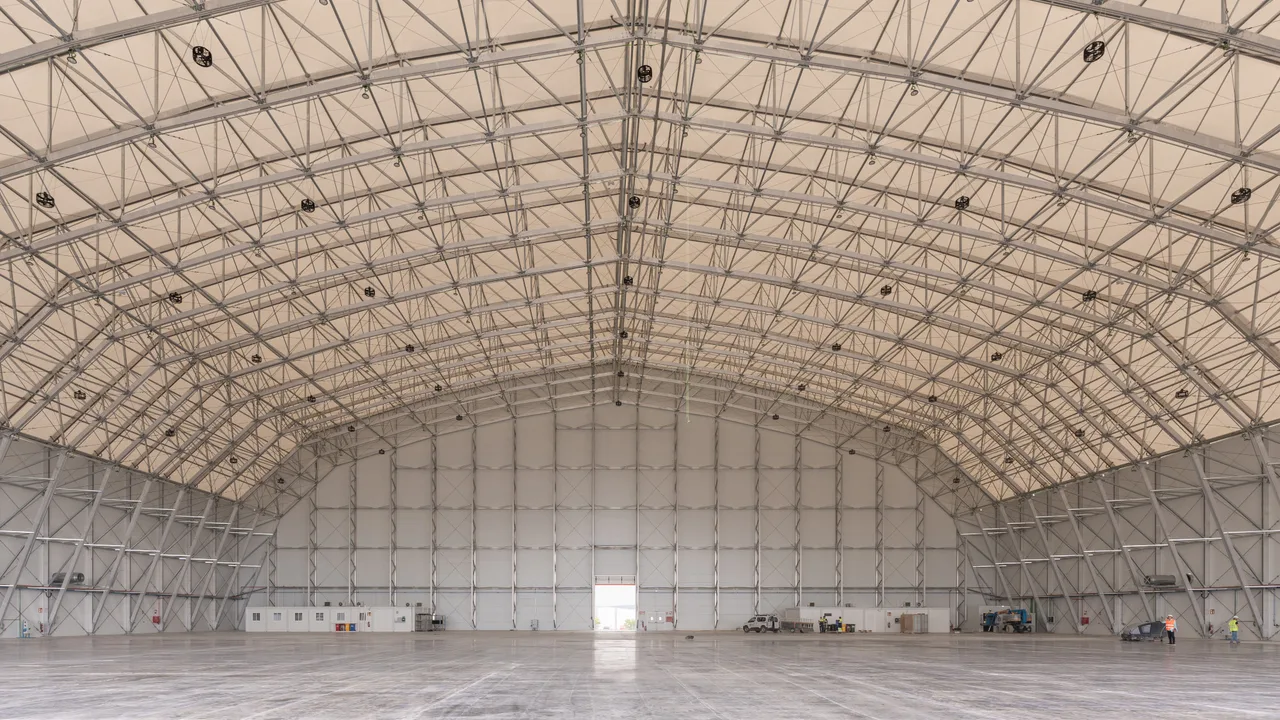
A hangar or a terminal concourse can put acres of membrane under one warranty, supported by long-span steel that moves with temperature and load in ways a small commercial deck never does. At that size, a roof is never in one condition; it is a patchwork of sections with different ages, systems, and remaining service lives. Treating it as a single asset leads to the two classic mistakes: replacing a whole roof when only one field needed attention, or chasing leaks for years across a roof that should have been replaced in zones. Thermal cycling, deflection, and drainage across these distances concentrate stress at expansion joints, ridges, and the long drainage runs that carry water to widely spaced points.
We assess these roofs with their scale and movement in mind rather than treating them as oversized versions of a strip-center roof. That means paying close attention to expansion joint condition, the integrity of long seam runs, drainage adequacy across the full span, and the way large rooftop equipment and skylight assemblies interact with a deck that flexes. Ponding that would be trivial on a small roof becomes a structural and membrane concern when it sits over thousands of square feet.
The Airside Environment
Roofs near active aircraft operations face exposures that drive both system selection and how work gets done. Jet blast, fuel and hydraulic exposure, de-icing chemicals, and constant exposure to wind uplift all shape what belongs on these buildings. Just as important, anything that can become foreign object debris is a safety issue, which restricts ballasted assemblies and loose materials in many airside locations and demands fully adhered or mechanically secured systems engineered for high uplift.
In our reviews we weigh the airside conditions specific to each building:
- Wind uplift ratings and attachment appropriate to exposed, high-wind locations
- Resistance to jet blast, fuel, and de-icing fluid where roofs sit near aprons and ramps, where PVC often earns its place
- FOD risk from ballast, loose flashing, or debris in proximity to taxiways and runways
- Reflectivity and energy performance on very large terminal roofs, where TPO and PVC are common choices
- Coordination with height, lighting, and obstruction requirements for any rooftop work or equipment near the airfield
24/7 Operations and Phased Work
Terminals and hangars do not close for roof work. Passengers move through the building around the clock, aircraft are maintained on schedules that cannot slip, and concession, baggage, and security operations continue beneath whatever is happening overhead. Above a terminal sit ticketing, security, baggage systems, and the electrical and IT infrastructure that water finds quickly, so a leak is never a maintenance ticket; it is a disrupted operation and frequently a closure decision. Roof projects here are phased, sequenced, and often performed at night or in tightly controlled windows, with temporary protection over occupied space and constant attention to keeping water out of an active building during the work.
We help owners understand the operational footprint of a roof scope before it begins, so that a reroof over a working concourse is planned around the building's life rather than imposed on it. That includes realistic phasing by section so gates and concourses stay in service, contingency for weather on a roof that cannot be left open, enforcement of FOD control in the scope before crews mobilize, and clarity on where badging, escort, and airside access requirements will affect schedule and cost.
Hangars and Maintenance Facilities
Hangar roofs carry their own profile. The clear spans are long, the doors create large openings that complicate the building envelope, and the interiors often hold high-value aircraft and in-progress maintenance work that a leak can damage directly, where contamination and corrosion are real concerns. Many hangars use standing-seam metal, modified bitumen, or single-ply systems over long-span structures, and on metal-deck assemblies spray polyurethane foam and high-performance coatings can extend service life and improve drainage without opening the building up. The failure points tend to cluster at ridge details, door header transitions, and the penetrations serving shop and mechanical systems.
For these buildings we focus on protecting what sits below: identifying where water intrusion would reach aircraft, avionics, or maintenance operations, and prioritizing repairs and capital around that exposure rather than around membrane age alone. We tell owners honestly when a coating buys real years and when it only postpones a replacement that should be budgeted now.
Warranty and Documentation Across a Campus
Airport facilities accumulate roofs over decades, across terminals, hangars, cargo buildings, parking structures, and support facilities, each with its own system, age, and warranty. Tenant improvements, airline build-outs, and equipment installs add penetrations that quietly erode coverage. We help owners maintain a clear record of what they have:
- System type, age, and warranty status mapped building by building
- Controls so tenant and vendor rooftop work preserves rather than voids manufacturer warranties
- Inspection and repair histories that support both warranty claims and capital planning
- Documentation that holds up under the scrutiny of public ownership and grant-funded improvements
Capital Planning for Public and Private Owners
Whether the owner is a public authority working within bond and grant cycles or a private operator managing return on aviation real estate, roof capital has to be timed deliberately, because the worst outcome is a roof that fails before its replacement was programmed. We give owners a portfolio view that ranks roofs by condition and operational criticality, identifies which assets can be extended through coatings or targeted repair and which need replacement in the next funding cycle, and frames each recommendation so it can survive board review, public scrutiny, or an investment committee. The goal is the same across both worlds: no roof becomes an emergency, and no closure is forced by a failure that planning could have caught.