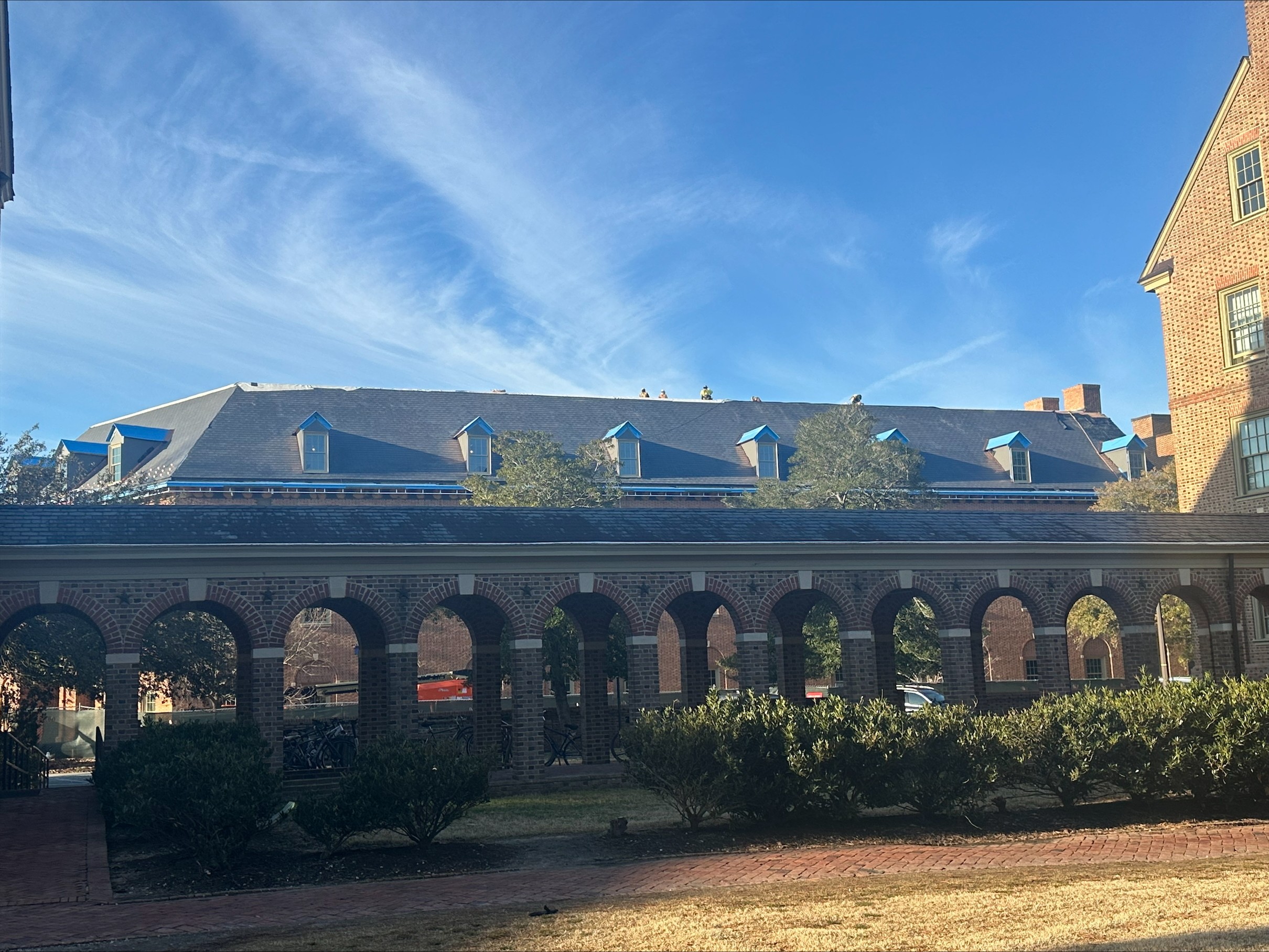
Federal Facilities
Federal facilities carry a roofing burden unlike any private portfolio. The buildings are mission-critical, the procurement is governed by Unified Facilities Guide Specifications and agency criteria, and the roof's service life has to be defended in writing against funding cycles that may not align with when the membrane actually fails. We advise federal building owners, facility executives, and the project teams supporting them on roof condition, risk, and capital strategy without holding an installation contract that would compromise our independence.
Why Federal Roofs Demand Owner-Side Advice
A federal roof rarely fails for a single reason. It fails because a 20-year-old built-up roof was patched annually instead of being budgeted for replacement, because a coating was applied over a saturated assembly to defer cost, or because a fast-tracked re-roof skipped the moisture survey that would have flagged wet insulation under the new membrane. We sit on the owner's side of every one of those decisions. Our role is to tell the contracting officer and the facility engineer what the roof actually needs, what it will cost to do correctly, and what the consequences are of deferring it another fiscal year.
Independence matters here more than in almost any other sector. When the entity assessing the roof is also the entity that wants to sell a re-roof, the assessment bends toward the sale. We do not install, so our condition findings, remaining-service-life estimates, and capital recommendations carry no upsell. That distinction is what makes our reports defensible in front of an inspector general, a budget review, or a warranty dispute.
Building to Federal Specifications
Federal roofing work is specified, not improvised. UFGS sections govern membrane type, attachment, fire and wind ratings, and submittal requirements, and agency-specific criteria from the GSA, the Department of Veterans Affairs, the Army Corps of Engineers, and others layer additional demands on top. We help owners translate those criteria into a buildable, biddable specification and then hold the installed work to it.
The system selection itself is rarely arbitrary. We weigh the realistic options against the building's use, exposure, and the agency's lifecycle expectations:
- TPO and PVC single-ply for reflective, low-slope roofs where solar reflectance and a long heat-welded seam life support energy and lifecycle goals.
- EPDM where puncture resistance, large-sheet coverage, and a proven long-term track record outweigh reflectivity needs.
- Modified bitumen and built-up roofing for high-traffic, redundancy-critical assemblies where a multi-ply system tolerates abuse and rooftop activity.
- Spray polyurethane foam and reflective coatings where the existing deck is sound and a restoration can responsibly extend service life without a full tear-off.
- Cover board over the insulation in nearly every assembly, because the hail, foot-traffic, and wind-uplift protection it provides is cheap relative to the membrane it defends.
Condition Assessment and Moisture Survey
Before any capital decision, we establish ground truth. A federal roof assessment from us combines a walked visual survey, core cuts to confirm the actual assembly and count plies, and non-destructive moisture detection using infrared thermography or nuclear and capacitance scanning to map wet insulation that no walkthrough would reveal. Saturated insulation is the single most common reason a re-roof underperforms: covering it traps water against the deck, corrodes fasteners, and voids the new warranty.
We document findings against a defined rating scale so the owner can compare every roof in a portfolio on the same terms, prioritize spending where failure risk and mission impact are highest, and produce the paper trail that federal capital requests require. The deliverable is built to survive scrutiny, not to justify a sale.
Warranty Governance and Quality Assurance
A manufacturer's no-dollar-limit warranty is only as strong as the documentation behind it and the conditions the owner unknowingly violates afterward. We protect federal owners on both ends. During construction we verify that installation matches the warranted system, that the manufacturer's field inspections actually happen, and that the closeout package, the warranty registration, the as-built details, and the inspection reports, is complete and held where the facility team can find it years later.
After turnover, we advise on the maintenance and documentation discipline that keeps the warranty enforceable: logging rooftop trade work, controlling who penetrates the membrane for new HVAC or communications equipment, and scheduling the inspections the warranty quietly requires. Most warranty denials we see trace back to an unrecorded penetration or a lapsed inspection, not a product defect.
Capital Planning Across the Portfolio
Federal funding is finite and cyclical, and roofs do not fail on a convenient schedule. We build multi-year capital plans that array every roof by remaining service life, replacement cost, and consequence of failure, so the owner can sequence replacements, fund targeted restorations to buy defensible time, and avoid the emergency procurements that cost more and bid worse. When a roof can be responsibly restored rather than replaced, we say so; when deferral is creating a hidden liability under the membrane, we quantify it.
Across a public portfolio, this is the difference between reacting to leaks and governing an asset class. We give federal owners a roof program they can defend line by line, fund with confidence, and hand to the next facility manager intact.