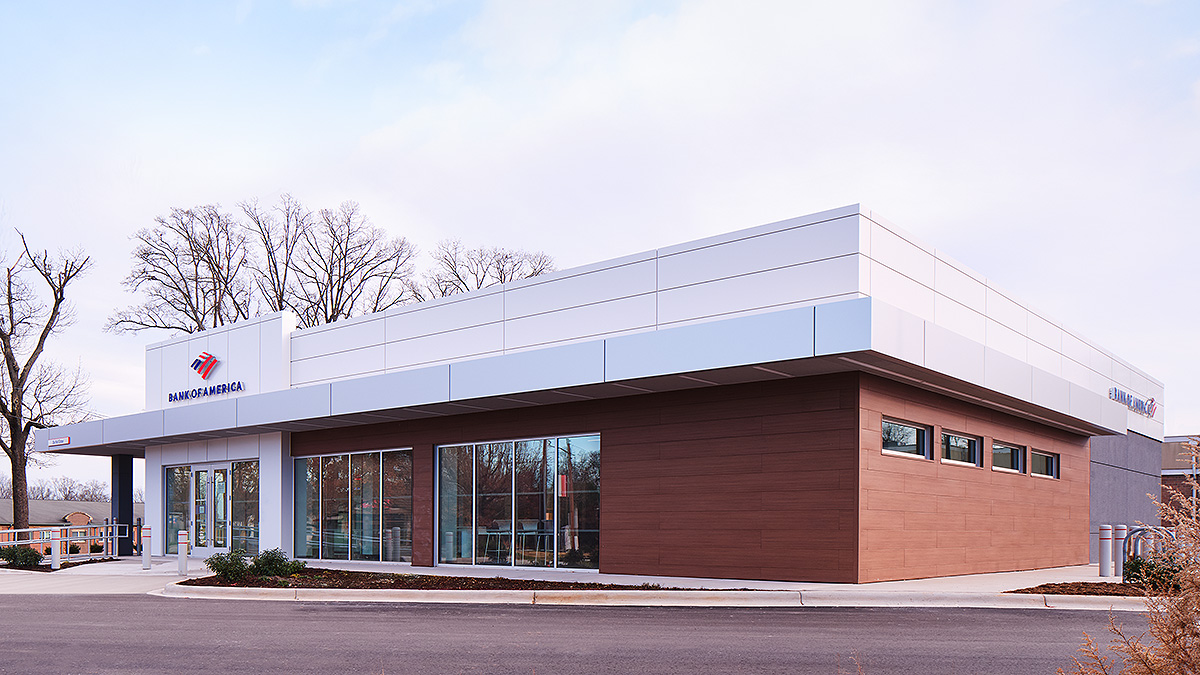
Banking & Finance
Banks, credit unions, and financial holding companies operate roofs that rarely look alike. A single institution may carry a 1970s downtown headquarters under an aging built-up roof, a string of branches on tired modified bitumen, and recently acquired locations whose roof histories arrived with no documentation at all. We advise these owners from their side of the table, turning a scattered branch network into a single, defensible view of roof condition, risk, and capital timing — with no stake in selling or installing any of the work we recommend.
The Branch Network Problem
Branch roofs fail quietly. A small leak over a vault, a server closet, or a records room becomes a business-continuity event long before it becomes a roofing project. Because branches are geographically dispersed and individually small, they tend to fall below the threshold that triggers attention at the corporate facilities level, so problems compound until a tenant complaint or an interior loss forces an emergency. Acquisitions make this worse: every merger and branch purchase folds in roofs the institution never inspected and warranties it cannot locate.
The financial consequence of that pattern is rarely visible on any single line item. Reactive, branch-by-branch spending feels small each time it happens, but across a network of dozens or hundreds of locations it routinely outspends a coordinated program while leaving the institution with no documentation and a portfolio of voided warranties. The roofs that get the least attention are often the oldest, and the ones most likely to fail in the same budget year.
We build a portfolio-wide condition baseline so leadership can see every roof on one scale. Rather than reacting location by location, the institution gets a ranked picture of where remaining service life is shortest, where moisture is already present, and where a modest repair today prevents a full tear-off in two years. That single view is the foundation for every capital and risk decision that follows.
What We Assess
Our reviews are written for asset and facilities decision-makers, not for the crew on the roof. We focus on the variables that actually move capital and risk across a dispersed footprint:
- Membrane type and age across the network — TPO, PVC, EPDM, modified bitumen, and older built-up assemblies — with realistic remaining service life for each.
- Infrared and capacitance moisture mapping to find saturated insulation before it spreads under the membrane and compromises adjacent areas.
- Warranty status and the documentation gaps that quietly void no-dollar-limit and material warranties when inspections or repairs go unrecorded.
- Exposure over vaults, data closets, and document storage, where a square foot of water does damage far out of proportion to its size.
- Drainage, flashing, and rooftop-unit penetrations — the failure points that account for the majority of branch leaks.
Each finding is tied to a recommended action and a rough timeframe, so a regional facilities lead can read the report and know not just the condition of a roof but what to do about it and when. We reference recognized NRCA and ASTM practice throughout, so the language is consistent from one location to the next and bids can be compared on a common basis.
Not All Square Footage Carries the Same Risk
A leak over a teller line is an inconvenience that gets mopped up before the branch opens. A leak over a cash vault, a network closet, or a records archive is a closure, a continuity event, and potentially a compliance problem. We help facilities and real estate teams rank roof sections by what they protect rather than by area alone, so monitoring attention and capital concentrate where a failure would actually interrupt operations.
Operations centers and data facilities deserve separate treatment from retail branches. These buildings carry concentrated technology and uninterrupted-uptime requirements, which lowers the acceptable risk on a marginal roof and raises the value of redundant drainage and tighter inspection intervals. We flag them as priority assets and recommend a lower risk tolerance than a standard storefront branch, because the cost of being wrong is measured in downtime rather than ceiling tiles.
Capital Planning Built for Regulated Owners
Financial institutions plan capital on disciplined cycles and answer to boards, examiners, and auditors. Roofs belong in that discipline, not in the unbudgeted-surprise column. We translate condition findings into a multi-year reserve and replacement forecast, so the institution can sequence roof spending across the network, smooth it against the deferred-maintenance cost curve, and avoid the clustering of emergency replacements that wrecks an annual facilities budget.
When a roof reaches the decision point, we lay out the options in financial terms: restore with a compatible coating system or SPF to extend service life at lower cost, or replace and reset the warranty clock. Each path carries different cash-flow timing, different energy implications from reflectivity, and different residual risk to the assets below, and we present them so the choice is informed rather than defaulted to whichever contractor called first.
How we support the capital cycle
- Multi-year replacement forecasts tied to documented condition and age rather than generic depreciation tables.
- Coating and restoration candidates that responsibly defer full tear-off where the deck and membrane allow.
- Sequencing that spreads roof capital across budget years instead of absorbing clustered failures at once.
- Roof-level inputs for reserve studies on owned real estate, reflecting real remaining service life.
Documentation That Survives an Audit
Real estate moves through financial institutions constantly — branches close, portfolios are acquired, owned locations are sold or refinanced. In every one of those events, a documented roof is an asset and an undocumented roof is a liability. We maintain an organized record for each location: condition history, warranty terms and registration, repair logs, and remaining-life estimates, all referenced to recognized standards.
That record does three things at once. It supports diligence when a property changes hands, it defends warranty claims when a manufacturer questions whether required maintenance occurred, and it gives the institution a clean answer when an auditor or insurer asks what condition the portfolio is actually in. Because the documentation lives with ownership rather than with a contractor, it survives staff turnover and vendor changes that would otherwise erase the institutional memory of what was done and what was promised.
Independent Review of Contractor Proposals
When a branch starts leaking, the institution usually receives a roofing proposal before it receives an objective opinion, and those two things are not the same. A facilities manager covering dozens of locations has little basis to judge whether a recommended tear-off is warranted, whether the scope is right-sized, or whether the price reflects the market. We close that gap by reviewing proposals and bids before the institution commits, comparing recommended scope against the documented condition we have on file and against what recognized practice would call for.
In many cases a proposed full replacement is premature, and a targeted repair or a restoration system buys years of additional service at a fraction of the cost. In others, a low bid omits the moisture removal or flashing work the roof actually needs, setting up a failure the institution will pay for twice. Because we never sell or install roofing, our reading of the proposal serves only the owner — giving leadership the confidence to approve, renegotiate, or decline based on what the building requires rather than on what the bid happens to say.
How We Work With Bank and Credit-Union Teams
Engagements typically begin with a footprint-wide inventory and condition baseline, move into warranty recovery and a multi-year capital forecast, and settle into a monitoring cadence with periodic reinspection so the record stays current as branches open, close, and change hands. The institution keeps full control of vendor selection and procurement; our role is to make sure every roof decision across the network is made on the same informed basis.
The outcome is durable institutional knowledge about the roofs the bank owns, the documentation to defend its warranty position, and a capital plan that finance and the board can actually rely on. We remain owner-side throughout, with no contracting interest and no incentive to recommend more scope than a roof needs — which is precisely what makes the assessment usable when it reaches the people who approve the spend.