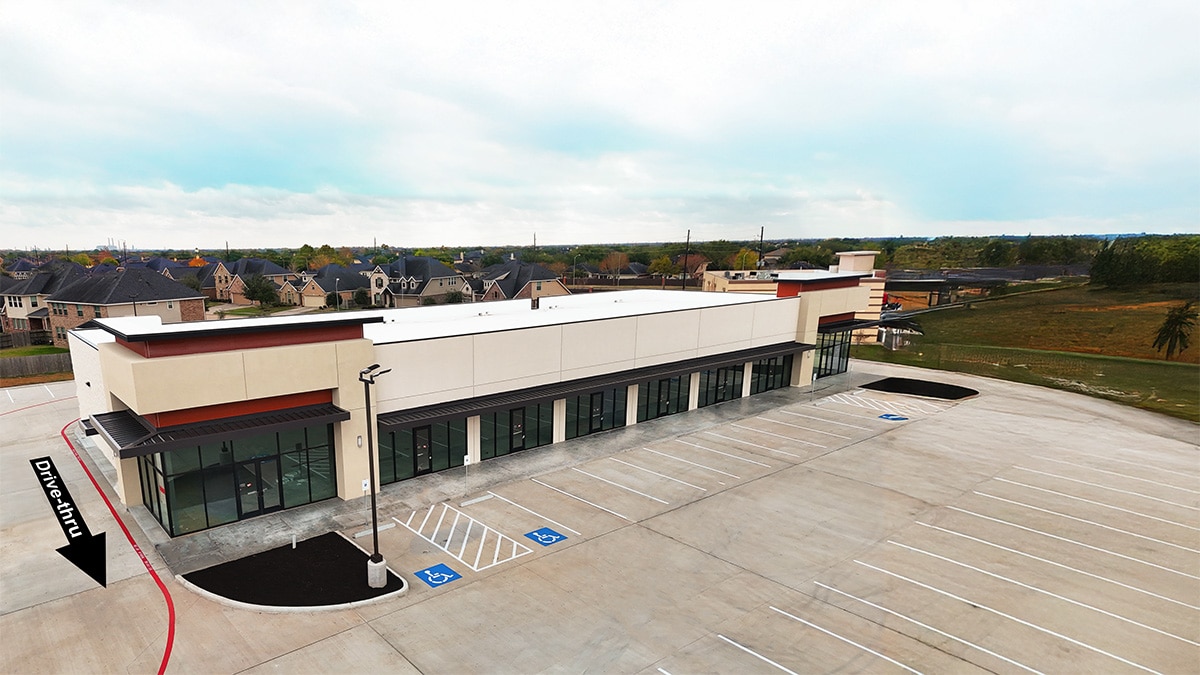
Regional Guide
The Gulf Coast asks more of a commercial roof than almost any region in the country. A flat or low-slope assembly here has to survive hurricane-force wind uplift, months of punishing solar load, near-constant humidity, and wind-driven rain that finds any unsealed seam or termination. When we advise building owners, REITs, and asset managers along the coast from Texas through the Florida panhandle, we frame every decision around one question: will this roof hold its edge and its membrane through the next named storm, and will it keep performing the other 360 days of the year? This guide explains the stressors that drive failure here and how we steer owners toward systems, details, and capital plans that actually last.
What the Gulf Coast climate does to a roof
The defining hazard is wind uplift. Hurricanes and tropical storms generate suction across the roof surface, and that suction concentrates at the perimeter and corners where pressures can run two to three times higher than the field. Most catastrophic roof losses do not start in the middle of the roof; they start when an edge metal, coping, or membrane termination peels back and lets wind get underneath the assembly. Once the edge fails, the field membrane unzips behind it.
Wind never works alone here. Heat is the second driver: intense, prolonged solar exposure accelerates membrane aging, drives thermal cycling that fatigues seams and fasteners, and bakes asphaltic systems until they embrittle. Humidity and wind-driven rain are the third: moisture that gets past a compromised detail does not dry out in this climate, so a small breach becomes saturated insulation, corroded fasteners, and substrate rot far faster than it would in a dry region.
- Perimeter and corner uplift — the highest-pressure zones, where edge metal and terminations fail first.
- Wind-borne debris — gravel, signage, and adjacent roof material that punctures membranes during storms.
- Prolonged UV and heat — premature membrane embrittlement and accelerated thermal-cycling fatigue.
- Standing humidity — slow drying that turns minor leaks into saturated insulation and corroded fasteners.
- Wind-driven rain — water forced horizontally and upward into laps, scuppers, and wall flashings.
- Salt exposure — accelerated corrosion of fasteners, edge metal, and rooftop equipment near the coast.
Which systems and details hold up here
No single membrane is automatically right for the Gulf Coast, but the attachment method and the detailing matter more than the chemistry. We generally favor white reflective single-ply membranes, principally TPO and PVC, because their high solar reflectance reduces the heat load that ages the roof and runs up cooling costs. PVC carries an advantage where rooftop grease, chemicals, or ponding are concerns. For owners who want maximum redundancy, a multi-ply modified bitumen or built-up system can perform well, but it gives up the reflectivity benefit unless coated.
Attachment is where storms are won or lost. Fully adhered membranes typically outperform mechanically attached systems in high-wind zones because they do not flutter and balloon under uplift. Where mechanical attachment is used, fastening patterns must be densified at the perimeter and corners, not just specified for the field. The non-membrane details deserve at least as much scrutiny as the membrane itself.
- Edge metal and coping rated and tested for the design wind speed, with cleats and continuous anchorage, not face-fastened trim alone.
- Enhanced perimeter and corner attachment sized to the elevated uplift pressures in those zones.
- Sealed, redundant flashings at walls, curbs, and penetrations, with cant strips and proper termination heights against wind-driven rain.
- Adequate drainage with primary drains plus overflow scuppers, because a storm can dump more water than a single drainage path can clear.
Inspection cadence for the Gulf Coast
In most of the country we recommend semiannual inspections. On the Gulf Coast we treat the calendar as storm-anchored. We advise a thorough inspection in late spring before hurricane season opens and a second in fall after the peak threat has passed, plus a documented post-storm inspection after any named system that affects the building, even if there is no visible interior leak.
Post-storm inspections are where owners protect both the asset and their insurance position. Wind damage is frequently invisible from the ground and sometimes from the roof surface: a coping that lifted and reseated, fasteners that backed out, or a seam that started to peel can look intact while the assembly is compromised. We document conditions with dated photography and, where moisture intrusion is suspected, infrared or capacitance moisture surveys to map wet insulation before it spreads. That documentation supports timely, well-substantiated claims and prevents a small post-storm defect from becoming a full tear-off two years later.
Capital-planning implications
Gulf Coast roofs age faster than the national averages owners often carry in their models. A single-ply membrane that might be modeled for a 20-to-25-year typical service life elsewhere can land at the lower end of that range here, and asphaltic systems shorten as well under the heat. We encourage owners to build reserves against the realistic local service life, not the manufacturer's headline number, and to fund the difference between a patch-and-extend strategy and a planned replacement before a storm forces the decision on the worst possible timeline.
Two line items deserve special attention in a coastal capital plan. First, edge-metal and termination upgrades are high-leverage spending: hardening the perimeter is often far cheaper than replacing the field, and it addresses the failure point that actually causes storm losses. Second, reflective coatings can be a legitimate mid-life intervention to extend a sound membrane and cut cooling load, but only on a roof that is dry and structurally sound underneath. A coating over saturated insulation or failing seams buys nothing but a delayed, larger bill, so we always condition a coating recommendation on a moisture survey and a seam assessment first.
How we advise owners on the Gulf Coast
We work on the owner's side of the table. We are not the installing crew, which means our recommendation on repair versus replacement, on system selection, and on contractor scope is not tied to selling a particular roof. On the Gulf Coast that independence matters most in two moments: when a storm has just passed and there is pressure to sign quickly with whoever shows up, and when a contractor proposes a coating or overlay that conveniently avoids the harder conversation about a wet, aging assembly.
Our process starts with an objective condition assessment and, where warranted, a moisture survey, so the decision rests on the actual state of the roof rather than on a sales pitch. We help owners write specifications that demand tested edge systems and densified perimeter attachment, we benchmark bids on equivalent scope so price comparisons are real, and we hold installers to the details that survive hurricanes. Across a coastal portfolio, that discipline turns roofing from a reactive, storm-driven expense into a planned, defensible line in the capital budget, and it keeps a single bad season from cascading into emergency replacements across multiple buildings at once.