Membrane Guide
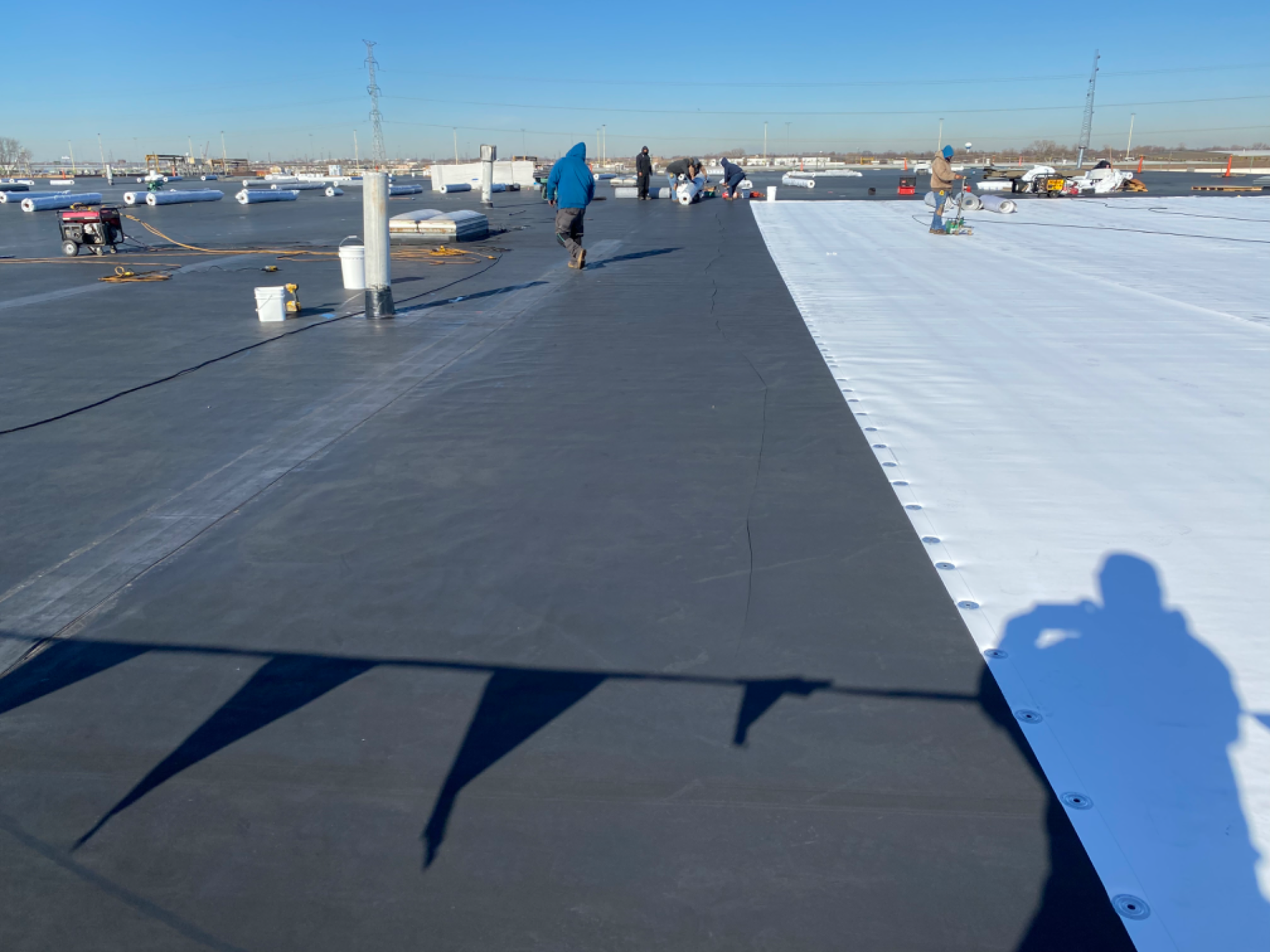
TPO and PVC are the two thermoplastic single-ply membranes that dominate low-slope commercial reroofing today, and they are close enough on the spec sheet that contractors often present them as interchangeable. They are not. The differences in chemistry, weld behavior, and field track record translate into real differences in service life, warranty exposure, and the conditions under which each one fails. As an owner-side advisor, our job is to keep you from buying the cheaper membrane into the wrong building. This guide frames the decision the way an asset manager should: by exposure, by warranty terms, and by total cost over the hold period rather than installed cost alone.
The Same Family, Different Chemistry
Both membranes are heat-welded thermoplastics, meaning seams are fused rather than glued, which is why both outperform the older fully-adhered EPDM seam in long-term watertightness. PVC (polyvinyl chloride) is the older, more proven chemistry and stays flexible through the use of plasticizers. TPO (thermoplastic polyolefin) was developed in the 1990s as a plasticizer-free alternative and has captured the majority of new low-slope installations on price and on the absence of plasticizer migration.
The plasticizer distinction is the crux of the comparison. PVC's flexibility depends on plasticizers that can migrate out of the sheet over decades, leading to embrittlement late in life. TPO has no plasticizers to lose, but earlier formulations had weatherability problems and a thinner weathering layer above the scrim, which produced field failures that the industry has since worked to correct through reformulation. Neither chemistry is uniformly superior; each fails in a characteristic way you can plan around.
Where PVC Earns Its Premium
PVC carries a meaningful cost premium over TPO, and there are buildings where that premium is non-negotiable. PVC's chemical resistance is the deciding factor whenever the roof is exposed to grease, animal fats, or hydrocarbons. We specify PVC over TPO in the following situations as a default:
- Restaurants, commercial kitchens, and any roof downwind of kitchen exhaust where grease deposition is constant.
- Food processing, rendering, and facilities with fryer or vegetable-oil exhaust.
- Roofs with chemical exhaust, solvent vapors, or industrial process discharge.
- Plaza decks, terraces, and any assembly requiring proven long-term seam reliability under foot traffic.
TPO will degrade where grease and oils contact it; PVC resists them. If your portfolio includes restaurant pads or food-related tenancy, the membrane choice is effectively made for you, and accepting a TPO bid on those buildings is a documentation problem waiting to surface in a warranty dispute.
Where TPO Is the Rational Choice
For the large category of warehouse, distribution, retail, office, and light-industrial roofs without aggressive chemical exposure, TPO is usually the correct economic decision. The membrane costs less, the reflective white surface delivers real cooling-load and energy benefit, and current-generation formulations have a far better weathering record than the early products that gave TPO its reputation. The savings on a large warehouse roof can be substantial without a proportional sacrifice in service life.
The caution with TPO is specification discipline. Membrane thickness, weathering-layer thickness above the scrim, and manufacturer formulation vary widely across the TPO market, and a thin sheet from a marginal manufacturer is not the same product as a thick sheet from an established one. We hold TPO bids to a minimum membrane thickness and a named manufacturer rather than letting the contractor substitute on price.
Reading the Warranty, Not the Brochure
The warranty length quoted in a bid is the least informative number in it. What matters to an owner is what the warranty actually covers and what voids it. A manufacturer's system warranty (NDL, or no-dollar-limit) is materially stronger than a contractor's workmanship warranty, and the two are routinely conflated in proposals. We read the following before treating any warranty as an asset:
- Whether coverage is NDL system or limited material-only, and whether labor is included.
- Membrane thickness and manufacturer required to qualify the warranty.
- Ponding-water exclusions, which are common and can quietly void coverage on a poorly draining roof.
- Maintenance and inspection obligations that, if undocumented, give the manufacturer grounds to deny a claim.
A twenty-year warranty with a ponding exclusion on a flat roof that ponds is worth less than a shorter warranty with clean coverage. We evaluate the warranty as a contingent liability transfer, not a marketing line.
Making the Capital Decision
The right way to choose between TPO and PVC is to start from the building's exposure and hold period, not the bid spread. If the roof sees grease or chemicals, specify PVC and stop comparing on price. If it does not, specify a quality TPO at a defined thickness from a named manufacturer and capture the savings. For a short hold where you intend to sell, a clean transferable warranty and documented condition matter more than squeezing the last few years of membrane life.
In every case, the decision should be documented: the exposure assessment, the membrane and thickness specified, the warranty terms accepted, and the rationale. That record protects the asset at sale, supports any future warranty claim, and keeps the next person managing the building from re-litigating a decision you already made correctly. The membrane is a twenty-year commitment; the hour spent choosing it deliberately is the cheapest part of the project.