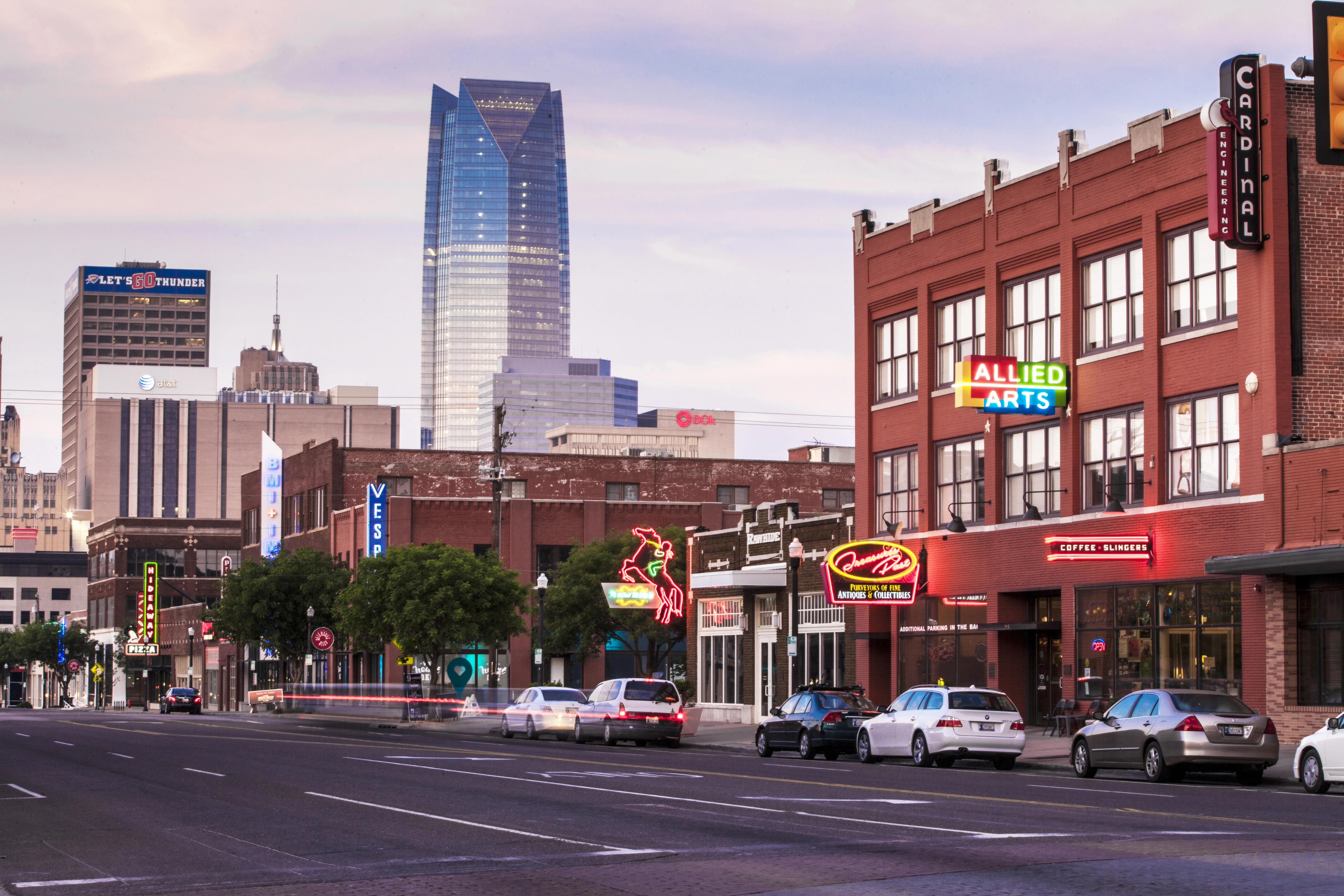
Oklahoma statewide
Oklahoma sits squarely in hail and wind country, where spring storms across Oklahoma City, Tulsa, and the surrounding plains routinely bruise membranes, fracture surfacing, and dent metal on commercial roofs in a single afternoon. Add intense summer UV, wide temperature swings, and straight-line winds, and even newer systems can age faster than their warranties suggest. For owners, hail claims, deductibles, and insurer scrutiny make roof condition a recurring financial question rather than a one-time decision. We advise building owners, REITs, and asset managers across Oklahoma on storm-damage assessment, impact-resistant specification, and capital timing that treats hail not as an accident but as a planned-for certainty.
Tornado Alley and the hail that comes with it
Oklahoma sits in the historic core of Tornado Alley, and the National Weather Service has logged thousands of confirmed tornadoes and tens of thousands of hailstorm and damaging-wind events across the state since 1950, with the season concentrated in April, May, and June. For commercial roofs, the headline risk is not only the rare direct tornado strike but the routine, repeated hail and straight-line wind that accompany the same storm systems. Hail bruises and fractures membranes in ways that may not leak for months, and wind drives rain under any flashing or edge detail that has begun to loosen. Layered onto that severe-weather exposure is a climate that runs humid subtropical in the east and semi-arid in the west, with long, hot summers whose UV and thermal cycling age membranes and dry out sealants statewide.
The failure patterns we document most often on Oklahoma assets reflect that environment:
- Hail bruising and puncture that quietly shortens membrane life long before a visible leak
- Wind uplift and edge-metal failure at perimeters, corners, and curbs
- Wind-driven rain forced under loosened flashings during severe storms
- UV and heat degradation of membranes and sealants through long, hot summers
- Storm-blown debris damage to single-ply and metal roof surfaces
- Ponding where flat decks and overwhelmed drains meet heavy convective rainfall
The building stock we manage here
Oklahoma's economy gives its commercial roofs a distinct profile. Energy remains a backbone — oil and natural gas operations, with major producers headquartered in the state — and that drives industrial, office, and field-support buildings across both metros. Aerospace and defense form a second pillar, rooted in Tinker Air Force Base in the Oklahoma City area, the state's largest single industrial operation, alongside a fast-growing private aerospace and maintenance sector with large hangar and shop roofs. Tulsa adds its own energy and aerospace base. Around those pillars sit the logistics, bioscience, healthcare, higher-education, and retail assets that fill Oklahoma City, Tulsa, Norman, and Stillwater — a mix of low-slope membrane, built-up, and metal roofs that each demand a different capital approach.
For an owner-side advisor, that variety is the point. A hangar roof, a distribution membrane, and a downtown office assembly carry different spans, slopes, and hail tolerances, and a credible plan treats each on its own terms rather than applying one rule across the portfolio.
The large-span metal roofs common on Oklahoma's hangars, manufacturing plants, and energy facilities deserve particular attention, because they fail differently than membrane. Hail dents and seam distortion may not leak immediately, but they compromise coatings and fastener seals in ways that accelerate corrosion under the state's heat and humidity. We assess these systems for the failure modes that actually govern their service life — seam and fastener condition, coating integrity, and corrosion at penetrations — rather than judging them by membrane standards that do not apply. For owners running mixed portfolios of metal and low-slope roofs, getting that distinction right is what keeps a capital plan honest.
Condition reporting after the storm — and before
In a hail and wind state, the most expensive mistake an owner can make is reading roof condition only after a storm, when contractor solicitations arrive uninvited and urgency clouds judgment. We document condition on a deliberate schedule and again after significant events, producing reports built for decisions: photographed defects tied to roof location, a defensible remaining-service-life estimate per section, moisture surveys where infrared or core sampling is warranted, and a clear separation of immediate, schedulable, and monitor-only items. That baseline is also what makes a hail or wind insurance claim defensible — establishing what the roof looked like before the storm, so genuine storm damage can be separated from ordinary wear. For owners holding many buildings, we standardize that reporting so the whole Oklahoma portfolio can be read on one consistent scale.
Capital planning under weather risk
Oklahoma's severe-weather exposure makes capital planning less about predicting the unpredictable and more about controlling what an owner can. We build multi-year plans that rank repair, restoration, and replacement by remaining service life, exposure, and budget year across the portfolio — and that explicitly weigh how a roof system will perform under hail and high wind, not just how many years it has left in calm conditions. That lets owners phase spending, cluster nearby buildings to control mobilization cost, prioritize the most storm-exposed assets, and choose impact-resistant systems where the math justifies the premium. It also keeps an owner out of the worst position: scrambling for emergency replacement at peak demand after a regional storm has already overrun every contractor in the metro.
The days and weeks after a major Oklahoma hail event are when owners make their costliest roofing decisions, and where independent advice earns its keep. Out-of-state crews arrive in force, knock on doors, and press for signatures on assignment-of-benefits and contingency agreements before anyone has objectively assessed the roof. Some of that work is sound; much of it is rushed, overscoped, or quietly voids the existing warranty. An owner moving fast under pressure can commit a portfolio to the wrong scope at the wrong price before the insurer has even inspected.
We give owners a way to slow that decision down without losing time. Working only for the building owner, we provide the steps that keep a post-storm response defensible and economical:
- An independent damage assessment that separates genuine hail and wind damage from pre-existing wear
- Documentation aligned with the insurance claim, so the scope reflects the actual loss rather than a contractor's estimate
- Evaluation of repair versus replacement on the roof's real condition, not a sales pitch
- Bid comparison on a common specification, so competing proposals can be read side by side
- Verification during construction that the installed system matches what was specified and what the warranty requires
Warranty exposure and contractor oversight
Warranties carry unusual weight in Oklahoma, and they are unusually easy to lose. Manufacturer and workmanship coverage gets voided by undocumented ponding, by uninspected rooftop work, or by the storm-chasing repair outfits that descend after every major hail event and patch roofs in ways that quietly break the warranty. We track warranty terms across the portfolio, flag the maintenance obligations that keep them valid, and coordinate any new rooftop work — including the equipment changes common on energy and aerospace facilities — so coverage survives. When replacement or major repair is justified, we help owners scope the work, compare bids on equal terms, and verify that what was specified is what gets installed. Because we hold no installation contract and take no contractor referral, that oversight answers to the owner alone.