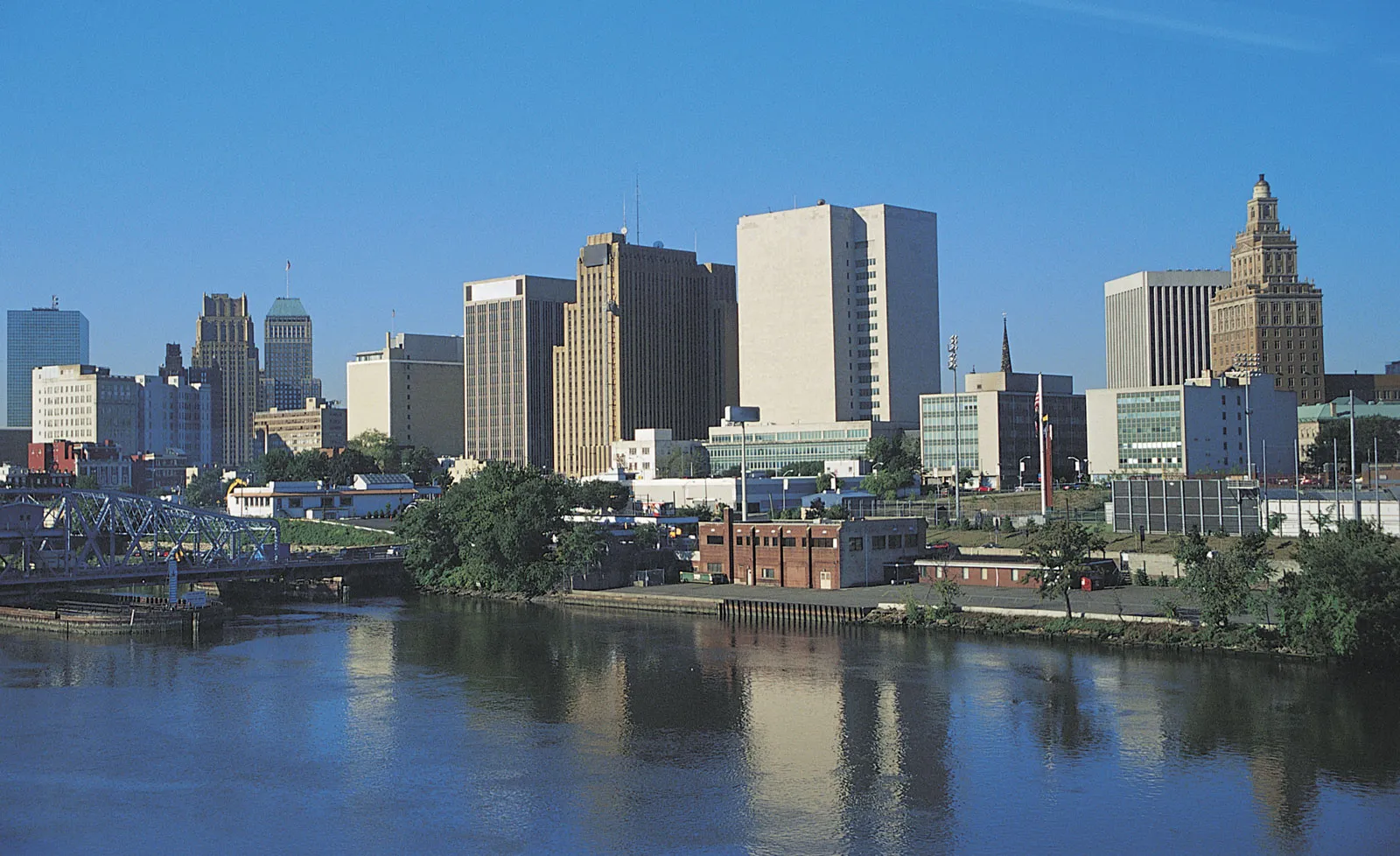
New Jersey statewide
New Jersey holds one of the densest concentrations of commercial roof area in the country, much of it on the warehouse and distribution stock focused on the largest container port on the East Coast. We advise building owners, REITs, and asset managers across the Port Newark-Elizabeth complex, the Meadowlands, the New Jersey Turnpike logistics corridor, and the life-science belt of the central and northern counties — representing owner interests on roofs we do not install, so the guidance is driven by the asset's life cycle and your capital plan, not by a crew's backlog. The state's roofs are shaped by a demanding combination: nor'easters and coastal storm surge, a full freeze-thaw winter, and acres of low-slope membrane carrying heavy mechanical loads.
The markets we cover across New Jersey
The logistics core is the Port of New York and New Jersey — Port Newark and the Elizabeth Marine Terminal — and the warehouse districts that radiate from it. Northern New Jersey's Meadowlands, around Lyndhurst, Secaucus, and Kearny, is the urban-adjacent distribution epicenter, with high-cube single-ply roofs serving import, fulfillment, and last-mile operations within minutes of New York City. Down the Turnpike, the Exit 8A and Exit 9 submarkets around Cranbury and South Brunswick hold the state's largest modern bulk-distribution buildings, where roof areas are measured in the hundreds of thousands of square feet per structure. These TPO and PVC membrane roofs are the defining commercial asset of the New Jersey industrial market.
Beyond logistics, New Jersey carries a deep life-science and pharmaceutical base concentrated along the Interstate 287 and Route 1 corridors through Morris, Somerset, Middlesex, and Mercer counties, where research, manufacturing, and headquarters buildings sit on roofs loaded with sensitive HVAC, clean-room, and process equipment. The northern office and flex markets near Newark and along Route 3, and the older industrial and mixed stock in cities like Jersey City and Paterson, round out a portfolio mix that often spans modern membrane warehouses and aging built-up assemblies within a single fund. We plan across all of it.
What actually drives commercial roof failure in New Jersey
The signature exposure is the nor'easter and the coastal storm. New Jersey sits in one of the most storm-vulnerable stretches of the Atlantic seaboard, where nor'easters and the occasional hurricane — Sandy remains the reference event — combine wind, prolonged heavy rain, and surge. For the flat roofs that dominate the state's warehouse and industrial stock, the failure pattern is wind uplift at perimeter edges and ponding intrusion when undersized or clogged drains cannot keep pace with a sustained downpour. Salt-laden coastal air across the eastern and shore counties adds steady corrosion of metal edge details, fasteners, and rooftop equipment.
The second driver is the freeze-thaw winter. New Jersey gets real cold, snow load, and repeated freezing and thawing, and water that enters a seam or flashing during a thaw pries the assembly apart as it refreezes — turning small defects into active leaks over a single season. The third is sheer scale and mechanical density: the enormous low-slope roofs on Turnpike-corridor warehouses and the equipment-heavy roofs on pharmaceutical and life-science buildings have miles of seam, hundreds of penetrations, and countless drains, every one of which is a potential point of failure. The recurring problems we plan around include:
- Wind uplift at perimeter edge metal and parapets during nor'easters and coastal storms
- Ponding and drainage failure under sustained heavy rain and storm surge
- Freeze-thaw cycling that opens seams and flashings into leaks over the winter
- Coastal salt corrosion of fasteners, edge metal, and rooftop units in shore and eastern counties
- Seam and penetration failure across the very large membrane roofs of the Turnpike logistics corridor
- Sealant and flashing breakdown around the dense HVAC and process equipment on life-science and pharmaceutical roofs
Condition reporting and capital planning for owners
For an owner or asset manager, our role is to turn a portfolio of roofs into a capital forecast that holds up to a lender, a board, or a buyer. We document each roof's assembly, age, drainage and insulation condition, and active deficiencies, then build a multi-year reserve plan keyed to your acquisition, hold, and disposition timelines. In a market where a single fund can hold a 600,000-square-foot Cranbury distribution roof, a Meadowlands fulfillment building, and a Somerset County lab in one portfolio, that granularity matters — the warehouse roof is usually governed by scale and storm exposure, while the lab roof is governed by the equipment loads and continuity-of-operations risk above sensitive interior space.
We set inspection cadence around the events that actually cause loss here: post-storm walks after major nor'easters to catch wind and ponding damage before it becomes interior loss, and a spring assessment to find the freeze-thaw damage the winter inflicted. For owners acquiring or repositioning New Jersey industrial and life-science assets — a constant in this market — we provide pre-acquisition roof due diligence so the capital liability is priced into the deal rather than discovered after closing. Given how quickly assets trade hands along the Turnpike corridor, that diligence frequently determines whether a roof should be replaced as a condition of sale, repaired to extend it through the next hold, or simply priced into the offer as a known liability the buyer will inherit.
Reroofing around occupancy and code in a dense market
In New Jersey, the operational reality of a roof project often matters as much as the roof itself. The state's largest distribution buildings run around the clock, and a fulfillment operation near the port cannot simply close while a roof is replaced — so the plan has to account for phasing the work over an occupied, active building, protecting inventory and staged trucks below, and sequencing tear-off so the building is never exposed to an incoming storm. We help owners weigh those constraints in the capital plan, because the cost and disruption of reroofing an operating warehouse is a real input to the hold-versus-replace decision, not a detail to sort out later.
Dense municipal regulation adds another layer. New Jersey's energy codes increasingly push toward reflective and well-insulated roof assemblies, and stormwater management is a live concern in the heavily built-out northern counties where impervious surface is tightly governed — which makes a reroof a moment when an owner may face new requirements rather than a like-for-like replacement. We flag those obligations early so they are budgeted and scheduled rather than discovered mid-project, and so a roof replacement becomes an opportunity to reduce operating cost and regulatory exposure rather than simply a sunk expense.
Warranty exposure and roofs across a New Jersey portfolio
Manufacturer warranties on single-ply systems are nearly universal on New Jersey's modern warehouse stock, and they are also where owners carry concentrated risk. Wind events beyond a stated threshold, ponding water past a defined duration, and unauthorized rooftop modifications — solar arrays, added HVAC and process curbs, telecom equipment — are routine grounds for a denied claim, and New Jersey roofs accumulate storm exposure and rooftop additions faster than most markets. We review warranty terms against field conditions, flag the modifications and maintenance lapses that void coverage, and maintain the documentation an owner needs to enforce a claim when a system genuinely fails before its time.
Managing roofs across a New Jersey holding means treating each roof as a system exposed to both Atlantic storms and a freeze-thaw winter, rather than a line item that surfaces only when it leaks. Whether you hold distribution space along the Turnpike and at the port, fulfillment buildings in the Meadowlands, or life-science and pharmaceutical facilities in the central corridor, our role is to give you an accurate picture of condition, a credible plan for spend, and protection of the warranties already on the books — owner-side, every time.