Owner's Guide
Owners are told a roof system lasts a fixed number of years, and that single figure ends up anchoring reserve studies, purchase negotiations, and capital plans. The figure is almost always misleading. A membrane's published service life assumes correct installation, an appropriate substrate, adequate drainage, and basic maintenance, conditions that hold on a minority of the roofs we inspect. What follows is a working guide to the commercial systems an owner is likely to hold, what genuinely drives their longevity, and how to read a manufacturer's number against the roof actually in front of you. The objective is not to memorize ranges but to know which questions move the estimate.
Single-Ply Membranes: TPO, PVC, and EPDM
Single-ply membranes dominate the modern low-slope market, and the three chemistries behave differently. TPO is a heat-weldable thermoplastic valued for its reflective white surface and competitive cost; the category has improved substantially over the years, but formulations and thickness vary, and thin membranes weather faster, particularly at the welds and where foot traffic concentrates. PVC is also heat-weldable and is the workhorse for roofs exposed to grease, chemicals, or restaurant exhaust, where TPO and EPDM degrade; its weakness is plasticizer loss over time, which can leave older sheets brittle. EPDM is a rubber membrane with a long field track record, typically dark-surfaced and very durable in the field, but historically dependent on adhesives and tapes at the seams, which is where aging EPDM tends to open up.
For all three, the seam is the system. We weigh membrane thickness, attachment method, and seam type far more heavily than the chemistry alone when estimating remaining life. Attachment matters here too: a mechanically fastened membrane behaves differently under wind and thermal movement than a fully adhered one, and a ballasted EPDM hides its field condition under stone until the ballast is parted. Two roofs of the same membrane and the same age can sit years apart in remaining life purely on how they were attached and detailed.
Built-Up and Modified Bitumen
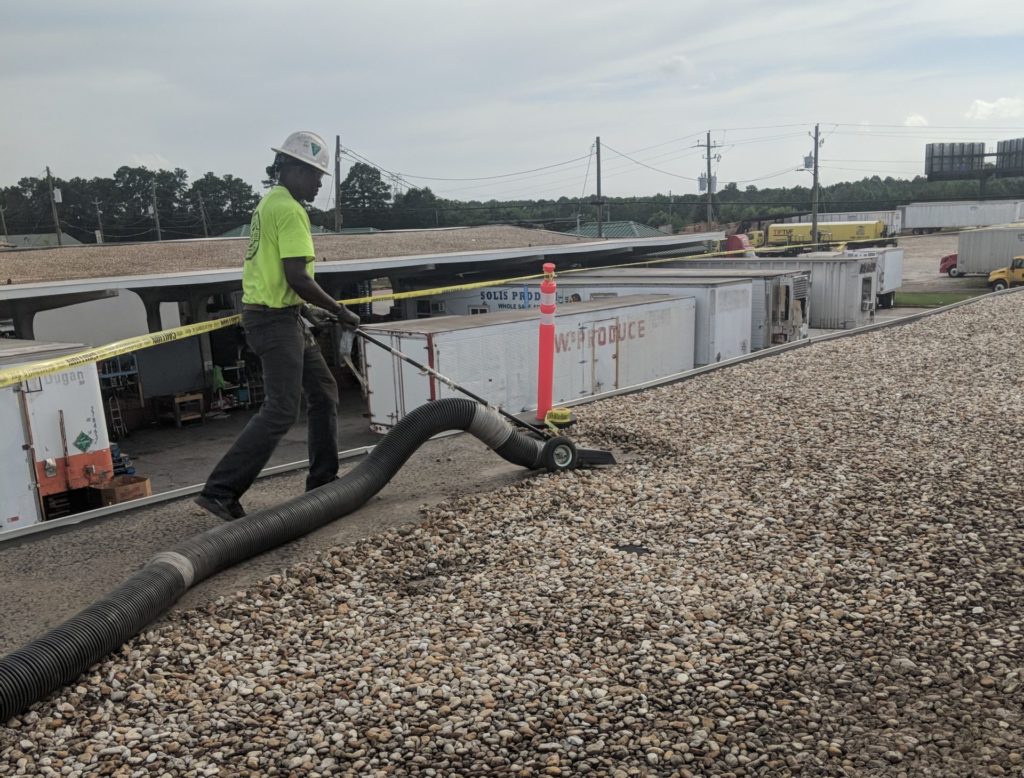
Built-up roofing, the classic multi-ply assembly of bitumen and reinforcing felts topped with gravel or a cap sheet, is among the most proven low-slope systems and remains common on older institutional and industrial buildings. It is heavy, redundant, and forgiving, but it is labor-intensive to install and repair, and blistering, ridging, and surface erosion mark its decline. Modified bitumen evolved from the same lineage, using polymer-modified asphalt sheets (APP or SBS) applied in fewer plies by torch, hot mop, cold adhesive, or self-adhered methods. It offers much of BUR's redundancy with easier installation and detailing.
Both asphaltic systems age visibly, which is an advantage for owners: surface cracking, alligatoring, and granule loss give honest warning before catastrophic failure, and both are strong candidates for restoration coatings while the membrane is still sound.
Spray Polyurethane Foam and Metal
Spray polyurethane foam (SPF) is applied as a liquid that expands into a seamless, insulating layer, then protected with a coating. Its seamlessness and self-flashing nature make it strong on complex roofs with many penetrations, and it adds insulation value directly. Its longevity, however, is almost entirely a function of recoating discipline: the protective coating must be renewed on schedule, and a neglected SPF roof degrades quickly once the foam is exposed to UV.
Metal roofing splits into two worlds. Standing-seam structural metal is a long-lived, low-slope-to-steep system whose service life is governed by the coating finish and the integrity of fasteners and seams. Exposed-fastener metal panels are more economical but rely on thousands of gasketed fasteners that back out and fail over time, making penetration and fastener maintenance the dominant variable. Both can be restored with appropriate coatings rather than replaced when the substrate is still sound.
Coatings and Restoration Systems
Fluid-applied coatings, acrylic, silicone, and polyurethane among them, are not a roof type so much as a life-extension layer over an existing one. Applied to a sound, dry substrate, a coating can add years of warrantied service, improve reflectivity, and defer replacement at a fraction of tear-off cost. Silicone resists ponding water well; acrylics are economical and reflective; polyurethanes offer abrasion resistance for traffic areas. The decisive limitation is the substrate: coatings encapsulate, they do not waterproof a wet assembly, so a moisture survey is a prerequisite before any restoration spend. Owners should also read the warranty behind a coating carefully, since terms range from a full labor-and-material guarantee to a thin material-only certificate, and most coating warranties are renewable on recoat. That renewability is the point: a coated roof maintained on schedule can be a managed, extendable asset rather than a system marching toward a single replacement date.
What Actually Determines Service Life
Across every system, the published lifespan is a ceiling that real-world conditions erode. The variables that move the number most are consistent:
- Installation quality, especially at seams, flashings, and penetrations, where most roofs fail first regardless of membrane.
- Drainage, because ponding water accelerates aging on nearly every system and voids many warranties.
- Substrate and insulation condition, since trapped moisture below the membrane shortens life invisibly.
- Maintenance discipline, including drain clearing, debris removal, and prompt detail repair.
- Foot traffic and rooftop equipment, which concentrate wear and create the penetrations that leak.
- Climate exposure, including UV load, thermal cycling, hail, and snow.
- Recoating cadence for SPF, metal, and coated systems, where deferral collapses service life.
This is why two roofs of identical age and system can warrant entirely different capital decisions. The membrane on the datasheet is the same; the roof on the building is not.
Using Service Life in Capital Planning
For an owner, the useful number is not the catalog figure but the evidence-based remaining service life of the specific roof, established by inspection, moisture survey, and review of installation and warranty records. That figure should feed the reserve study, inform whether the next move is repair, restoration, or replacement, and align with the asset's hold period. A roof with documented life remaining is a smaller line item and a stronger position in a sale or refinance; an undocumented one invites the buyer or lender to assume the worst. We help owners convert system knowledge into a defensible remaining-life estimate per roof, so capital is timed to condition rather than to the calendar or to whichever vendor calls first.